Casa Grande Residence Security: Face Recognition & Access Cards
Apartment Security in Jakarta: How Casa Grande Residence Protects Residents
For many expatriates, apartment security in Jakarta is as important as the size of the unit or the facilities. Casa Grande Residence is a high-end vertical residence in South Jakarta, directly connected to the Kota Kasablanka shopping centre. Its management combines two systems: face recognition and a multi-tier access card system.
This guide explains in plain terms how each layer works, what it means for daily life and for visitors, and what you should still confirm with the agent before you sign.
Why a Mall-Connected Apartment Needs Stronger Security
Living next to a mall is convenient: you can walk to shops, restaurants and entertainment. The trade-off is heavy foot traffic around the public areas, so a firm boundary is needed between the mall and the residential zone.
Security based only on guards at a post and a paper guest book is considered no longer enough for a modern residence. The building instead uses automated systems that screen people in real time and reduce human error.
Face Recognition at the Main Entrance
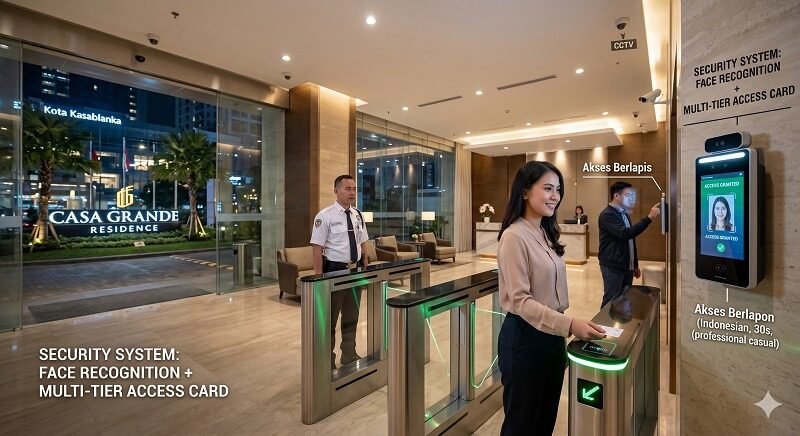
Face recognition is the first line of screening. It scans the unique features of a face and matches them against the official resident database managed by Building Management.
When a resident approaches the main lobby entrance or the residential turnstile gate, a high-resolution camera captures the face and the system unlocks access automatically if the data matches.
- Anti-tailgating: the system is combined with automatic barriers that open for one person per scan, which helps stop strangers from following a resident in.
- Touchless: residents do not need to touch any device, which suits people who care about hygiene.
- Liveness detection: the cameras can tell a real face from a photo on a phone or a paper print, reducing the risk of identity fraud.
Layered Access Cards from the Gate to Your Front Door
If face recognition screens people at the main entrance, the multi-tier access card system controls where each person can go inside. The building is divided into security zones that are separated from one another.
Layer 1: Vehicle Entrance
Residents arriving by car or motorcycle tap an access card (a proximity card or long-range RFID) on the automatic gate. Visitors without a card are directed to a separate lane, where security staff check identity and exchange it for a visitor card.
Layer 2: Lobby and Lifts
After the parking area or the bridge from the mall, the card is needed again to open the glass lobby door. Inside, it must be tapped on the lift control panel, known as a Lift Destination Control System.
The resident card is programmed so the lift allows only the shared facility floors, such as the swimming pool or gym, and the resident's own floor. You cannot reach other residents' floors, which protects privacy between neighbours.
Layer 3: Smart Digital Door Lock
The last layer is the unit door. Units are generally fitted with a premium smart digital door lock, opened with the same access card, a secret PIN code or a fingerprint. The door locks automatically once closed, so you cannot forget to lock it.
Security Staff and Guest Management 24/7
Technology does not replace people. Management combines it with professional security personnel on duty 24 hours a day.
Face scans and card usage history are monitored centrally through smart CCTV cameras in corridors, emergency stairs, the basement and outdoor gardens. If something unusual happens, such as a card repeatedly tapped in a restricted area, an alarm sounds in the control room and the nearest officer is sent to the location.
For guests and relatives, residents can arrange temporary access or register the guest's name with building management in advance. Guests receive a visitor card with limited time and movement range.
What to Check Before You Rent or Buy
The source describes the system in general terms, so confirm the details for your specific unit. Ask the agent how to register family members, domestic staff and regular visitors in the face recognition and card systems, and how lost cards are handled.
Also ask which door lock the unit has, since units are described as generally fitted with a smart lock rather than all of them. Prices and availability can change, so ask the agent for current figures and terms.
Find Your Home at Casa Grande Residence
If privacy and security are high on your list, Casa Grande Residence is worth a viewing. Contact our team to arrange a visit, see the access system in practice and compare available units with your needs.
Frequently Asked Questions
Does Casa Grande Residence use face recognition?
Yes. Face recognition at the main lobby entrance and the residential turnstile gate matches faces against the resident database managed by Building Management.
Can residents reach other floors in the lift?
No. The access card is programmed so the lift only allows shared facility floors and the resident's own floor.
How do guests enter the building?
Residents can arrange temporary access or register the guest's name with building management in advance. Guests receive a visitor card with limited time and movement range.
What kind of lock do the units have?
Units are generally fitted with a smart digital door lock that opens with an access card, PIN code or fingerprint, and locks automatically when closed.
Is the building monitored at night?
Yes. Security personnel are on duty 24 hours a day, and activity is monitored centrally through CCTV.